Evaluating experience investment in accommodation discovery through generative AI
Abstract
Generative artificial intelligence (AI) can select and reformulate guest reviews when recommending accommodation. This creates an investment question for operators: under what conditions does improving an experience produce additional economic value through the customer information subsequently used by these systems? Existing research explains customer influence, electronic word of mouth (eWOM), synthetic recommendations and marketing incrementality, but findings at these different levels cannot be substituted for one another when evaluating an operator’s investment. This conceptual paper integrates those literatures around a defined decision: evaluating expenditure on guest experience and the resulting customer evidence. It develops a framework connecting experience, evidence, AI representation and retained contribution, with explicit attention to traveller response, competing pathways and feedback. Conditional implications identify circumstances in which increased visibility and economic value may diverge. The analysis distinguishes a programme’s total incremental effect, customer influence and AI-mediated customer influence, and derives a measurement protocol and a three-arm investment test. The contribution aligns communication mechanisms with investment comparisons in a setting characterised by varied trip requirements, date-specific capacity and intermediation. For practice, it explains why inaccessible information, inaccurate representation, constrained demand and costly channel substitution require different investigations and responses. The framework provides a basis for evaluating experience investment without mistaking recommendations for additional profit.
Introduction
Introduction
A good stay can influence people who have never visited the property. Guests describe whether a room was quiet, whether a family could settle comfortably, or how staff responded when travel plans failed. Those accounts can help subsequent travellers judge suitability. The commercial significance of such influence is established: customers contribute through their effects on other customers as well as through their own purchases (Kumar et al. 2010). Generative artificial intelligence (AI) adds a setting in which that information can be selected, condensed and reformulated before another traveller encounters it.
Consider an accommodation operator deciding whether to redirect part of a paid-search budget into better sleep conditions and a programme requesting honest post-stay feedback. The proposal contains several different expectations: guests experience an improvement; some describe it; a generative service can access the descriptions; its recommendations represent the improvement appropriately; travellers act differently; and the resulting business exceeds the programme’s costs. An increase in positive reviews or recommendation frequency could support part of that account. It would not establish the financial return of the reallocation.
Research provides a substantial foundation for evaluating this possibility. Hotel-ranking research incorporated user-generated content into preference-sensitive recommendations (Ghose et al. 2012). Tourism-specific conceptual work subsequently examined generative systems synthesising reviews into recommendations (Mladenović et al. 2024). The broader synthetic word-of-mouth (WOM) literature now conceptualises AI as a creator, mediator, evaluator and potential actor in consumption-related communication (Haenlein et al. 2026). Marketing Science
The unresolved problem addressed here is an alignment problem between the object studied and the decision being made. A study of review production observes customer communication. An audit of generated answers observes a system’s outputs. An experiment on recommendation acceptance observes a consumer response. An operator deciding where to spend the next dollar needs an estimate of additional contribution under an alternative investment policy. Each perspective is useful, but moving between them requires assumptions about transmission, behaviour, substitution and costs. This paper makes those assumptions explicit for accommodation discovery.
The research question is: How should accommodation operators evaluate the incremental contribution of guest-experience investment when generative AI mediates customer evidence? The focal unit is an accommodation property or portfolio, and the focal decision is an intervention relative to a specified alternative over a stated period. The article concerns generative recommendations and review summaries encountered by human travellers. Fully autonomous booking agents, general organisational AI adoption and destination-wide welfare are outside its primary scope.
The contribution is a conceptual synthesis with three connected elements. First, it translates established customer-influence and synthetic-WOM concepts into an operator-level framework that distinguishes experience, evidence, AI representation and retained contribution. Second, it separates the financial effect of an investment policy from the particular mechanisms through which that effect might arise. Third, it derives conditional implications that distinguish investments worth testing under different constraints. The integration matters in accommodation because varied trip requirements, date-specific capacity, booking intermediation and the delay between a stay and its influence on later guests can produce different investment decisions despite similar visibility measures.
The argument also preserves an operational possibility that marketing measurement can obscure: improving a stay may generate demand beyond the guest who purchases it. Recognising that possibility warrants investigation, not a presumption that experience investment outperforms advertising. The following sections explain the conceptual approach, locate the contribution against prior literature, develop the framework and set out its evaluation and practical implications.
Conceptual foundations and the unresolved decision
Customer influence is broader than advocacy
Customer influence is broader than advocacy
Kumar et al. (2010) distinguish customers’ purchases, incentivised referrals, influence on other customers and knowledge contributions. That framework already recognises value beyond direct transactions and the need to consider what influenced customers would otherwise have done. This article therefore uses customer influence rather than introducing advocate value as a new economic construct. pure.rug.nl
Advocacy remains relevant but narrower. Sweeney et al. (2020) distinguish advocacy from ordinary positive WOM. A photograph showing a stairway, a neutral description of room layout or a negative account of noise may inform a decision without expressing committed endorsement. Here, customer evidence means customer-generated information about an experienced service that can inform another decision. The term identifies the information’s role; it does not certify its authenticity, representativeness or accuracy, and it does not turn public content into a formal research dataset.
The electronic word-of-mouth (eWOM) process is also well developed. Babić Rosario et al. (2020) distinguish creation, exposure and evaluation within a recursive process. Their consumer-centred definition places boundaries around recommendations modified through marketer algorithms. Later synthetic-WOM accounts extend attention to machine participation. These definitions should not be collapsed: an original review, an AI-generated account of it and the traveller’s interpretation are different objects even when they form part of the same influence process.
Hospitality evidence provides a substantive foundation. Yang et al.’s (2018) meta-analysis links review characteristics with hotel performance while showing variation across settings and methods. Cho et al. (2024) examine actual bookings and competing hotels’ reviews, demonstrating the importance of review attributes and competitive context. These studies make hotel demand, not merely generic technology adoption, central to the problem. They do not imply that any additional review creates an additional stay or that effects transfer unchanged into generative interfaces. ScienceDirect
Generative representation is a distinct object of analysis
Generative representation is a distinct object of analysis
The computational use of hotel reviews predates current conversational services. Ghose et al. (2012) combine review information with other hotel attributes in ranking-system design. Mladenović et al. (2024) subsequently conceptualise generative AI aggregating and synthesising tourism WOM across travel phases. Haenlein et al. (2026) extend synthetic-WOM analysis across source, message, channel and receiver. These accounts establish why reformulated information warrants analysis separately from its original source.
AI representation denotes the property descriptions, comparisons, summaries and recommendations produced by a specified generative service under recorded generation and display conditions. These include the query and session where applicable; a platform may instead generate a review summary in advance and display it across visits. Representation includes whether a property appears, which attributes are emphasised, whether qualifications survive and how sources are presented. A mention is therefore only one dimension of representation.
Systems also differ in how they obtain information. Retrieval-augmented generation combines model parameters with retrieved material (Lewis et al. 2020). A newly accessible review may affect a retrieved answer without having become part of model training. Conversely, observing an answer does not reveal proprietary training data or prove that a particular review influenced it. An output can combine customer, operator, platform and other material. A source citation must be assessed for actual support, rather than treated as a reliable trace by its presence alone (Liu et al. 2023). proceedings.neurips.cc
Tourism studies already show conditional responses to such outputs. Wang et al. (2026a) examine WOM-based conversational recommendations, trust, acceptance and transparency. Jia et al. (2025) find source- and valence-dependent responses to AI and human review summaries in scenario experiments. These are relevant to how representations are received, but acceptance and booking intention are not realised incremental contribution.
Qualitative findings also retain traveller agency. Cai et al. (2026) report that interview participants used hotel-review summaries for efficient screening while questioning completeness and consulting original reviews. Wang et al. (2026b) associate positively biased summaries with expectation mismatch and lower subsequent evaluations in a Ctrip setting. These findings motivate attention to accurate suitability, including negative or qualifying details. They do not establish that all summaries mislead or that travellers universally delegate their decisions. tandfonline.com
Influence, transaction routes and retained contribution
Influence, transaction routes and retained contribution
Customer journeys were never fully observable. Lemon and Verhoef (2016) include touchpoints controlled by customers, partners and external actors. Moreover, hospitality-specific work by Li and Kannan (2014) already models incremental multichannel attribution and evaluates predictions against a paid-search interruption. Their work is a close predecessor to the present investment question, although its model-based validation should not be described as a randomised trial.
Attribution allocates credit under a specified model; incrementality concerns a counterfactual difference. Some attribution methods explicitly seek incremental effects. It would therefore be inaccurate to equate all attribution with last-click reporting or to suggest that causality became necessary only when AI entered discovery.
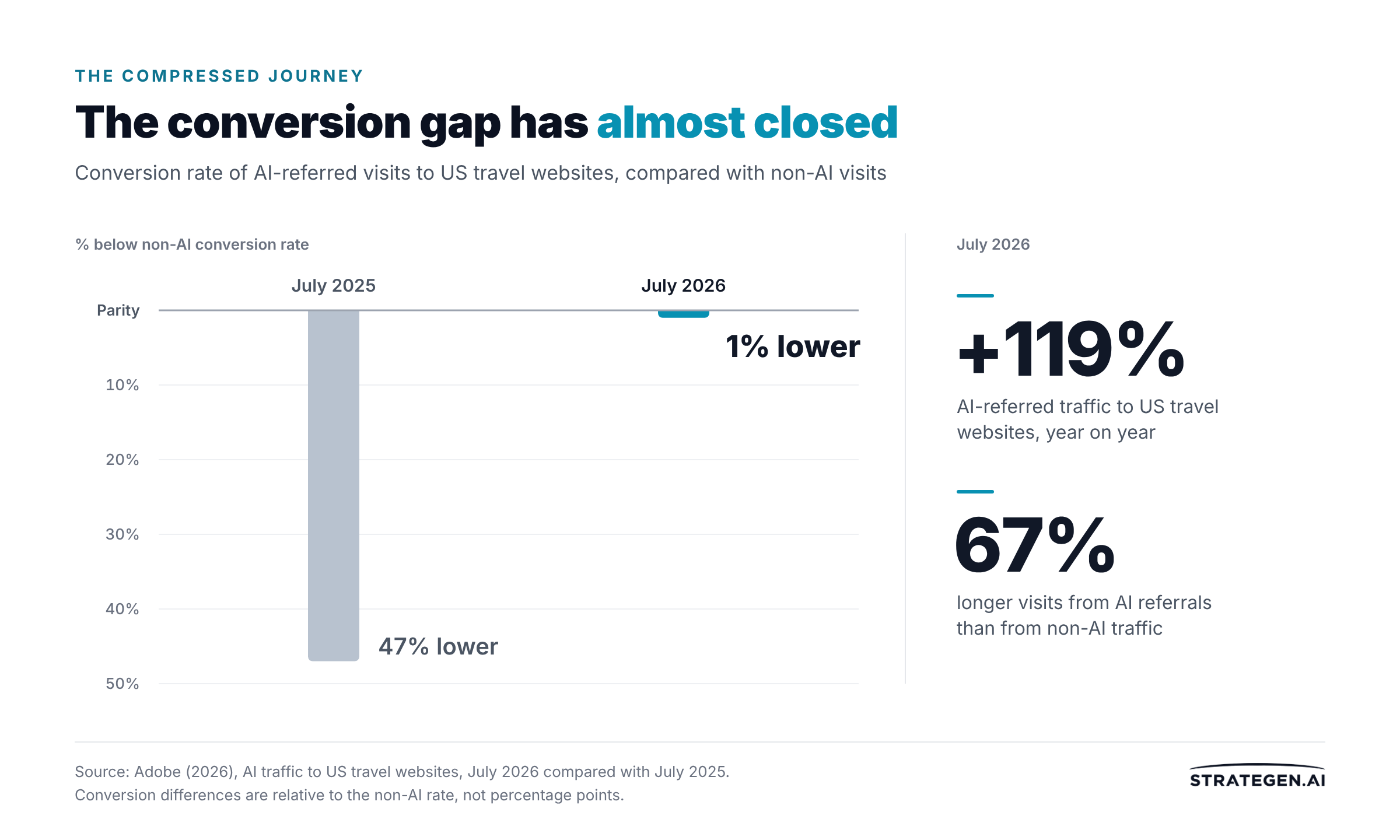
Recent industry analytics illustrate the growing relevance of this distinction. Adobe Digital Insights reported that AI-referred traffic to US travel websites increased by 119% year-on-year in July 2026, while its conversion rate moved from 47% below non-AI traffic in July 2025 to just 1% below in July 2026. Although these findings suggest that AI referrals have become a more commercially significant source of website traffic, they do not establish where earlier consideration occurred, which information influenced the traveller, or whether the resulting transactions represent incremental economic value (Pandya, 2026).
The source of influence, the host of information and the booking channel can also differ. Anderson’s (2009) small, historical hotel study illustrates online travel agency (OTA) exposure coinciding with higher reservation volume outside Expedia. O’Connor et al. (2025) report a positive aggregate association between agency-model OTA activity and hotel profitability in cross-sectional US data. Neither establishes present-day AI effects. Both caution against assuming that a commission-bearing booking necessarily destroys operator value or that discovery and transaction occur in the same place. ecommons.cornell.edu
Table 1 locates the specific task of this synthesis. The inadequacy is not an absence of customer-influence or tourism-AI theory. It is that findings about different objects do not by themselves specify the financial claim an operator can defend about a particular intervention.
Table 1 Established explanations and the operator decision addressed here
| Literature | Established analytical contribution | Additional task for the focal decision |
|---|---|---|
| Customer engagement and influencer value | Distinguishes purchases and indirect customer contributions (Kumar et al. 2010) | Define an intervention, counterfactual and accounting boundary when individual influence cannot be traced |
| eWOM and synthetic WOM | Explains communication processes, feedback and machine transformation (Babić Rosario et al. 2020; Mladenović et al. 2024; Haenlein et al. 2026) | Determine which changes in accessible customer information survive into relevant representations |
| Tourism recommendations and summaries | Examines ranking, acceptance, trust, intentions and experience evaluations (Ghose et al. 2012; Jia et al. 2025; Wang et al. 2026a, b) | Connect the measured response to additional completed business under actual rates, availability and competition |
| Attribution and distribution economics | Examines channel interactions and commercial outcomes (Li and Kannan 2014; O’Connor et al. 2025) | Distinguish the total investment effect from AI mediation and reconcile all-channel contribution |
Source: Author’s synthesis of the cited literature. The final column specifies tasks for this framework, not claims that the preceding literatures are silent about every element.
A framework for evaluating experience investment
Four layers and several possible pathways
Four layers and several possible pathways
The framework connects experience, evidence, AI representation and retained contribution. Its purpose is to organise claims and identify where additional evidence is needed. It is not a deterministic funnel: some guests never contribute public information, some representations use other inputs, and improved experiences can create value through pathways that bypass AI entirely.
Experience concerns what was delivered and for whom. Evidence concerns what customers communicate, its content and the conditions under which a system can access it. Representation concerns the generated account encountered by a traveller. Retained contribution concerns the operator’s economic outcome after relevant costs. Traveller exposure, interpretation, choice and completed consumption connect representation to that outcome. They cannot be assumed simply because a system produced a favourable answer.
The distinctions organise competing diagnoses. If a service improvement is not experienced, additional content activity cannot establish its delivery. If guests describe it but relevant systems cannot access those descriptions, information access is a plausible constraint. If accessible accounts are misrepresented, producing more generic praise may leave the problem intact. If recommendations are accurate but dates are unavailable, capacity is a different explanation. These patterns select questions to investigate; they do not identify causes by themselves. Low mentions and low bookings, for example, cannot establish an access failure. Table 2 makes the evidential distinctions operational.
Table 2 Claims, observations and decisions across the framework
| Layer | Useful observations | Claim supported and decision informed |
|---|---|---|
| Experience | Delivery records, complaints, recovery outcomes and segment-specific satisfaction | Establish whether the intended improvement occurred; correct the service before assuming communication will solve the problem |
| Evidence | Participation, recency, attribute coverage, qualifications, contributor mix and source accessibility | Establish what information exists and can be inspected; address missing or inaccessible information without prescribing sentiment |
| AI representation | Appearance across defined queries, attribute accuracy, omission of qualifications, source support and repeated-output variation | Establish behaviour under recorded test conditions; select tests of inaccurate descriptions or access differences without equating mentions with market exposure |
| Traveller response: the bridge | Actual exposure, interpretation, verification, choices and subsequent behaviour | Determine whether produced outputs were encountered and how travellers responded; distinguish informed selection from visibility alone |
| Retained contribution | Completed stays, realised rates, cancellations, distribution and servicing costs, actual investment and a credible comparison | Estimate an intervention’s additional economic contribution; separate new demand, substitution, retention and costs |
Source: Author’s synthesis. Traveller response connects the representation and contribution layers. Observations in an earlier row do not establish the outcome in a later row.
Information quality and representation
Information quality and representation
The value of customer information depends on the decision it informs. For a traveller seeking quiet accommodation near a convention venue, a general positive rating and a specific account of overnight noise are different inputs. For someone assessing accessibility, the loss of a qualification about stairs can change suitability. These are illustrative scenarios, not observations from an organisational study.
The synthesis suggests examining the interaction between attribute-specific information and its preservation in the generated answer. Cai et al.’s (2026) accounts of omissions and verification provide a tourism antecedent; they do not establish the proposed intervention effect. The relevant test would compare changes in decision-relevant information and generated descriptions while documenting access, query conditions and other property information.
Proposition 1. For travellers with the same independently specified requirements, adding previously absent, verifiable experience details improves recommendation suitability more when queries express those requirements than when they leave them implicit, conditional on source access and comparable valence, content quantity and service quality.
Recommendation suitability concerns accurate matching to an independently specified traveller profile, rather than higher ranking or positive tone. A controlled, permissioned corpus could cross the presence of relevant details with whether the query expresses the profile’s requirements. All conditions would use the same suitability rubric; factual preservation would be coded separately. This applies established relevance logic to the choice of which experience details to evaluate. No differential improvement would weaken the proposition. Domain authority, evidence redundancy or loss of qualifications during synthesis could dominate the relevance effect. Preserving a material negative qualification may appropriately reduce recommendations for one segment.
Visibility and economic consequences
Visibility and economic consequences
An increased probability of appearing in an answer can have different commercial consequences at different properties or times. Where potential guests already intend to book, additional visibility may change the route rather than the decision. At constrained dates, it may change price, cancellation risk or customer mix without adding stays. Where spare capacity and low prior awareness coincide, additional demand is possible, but price, suitability and competition still matter.
These conditions discipline the outcome measure rather than constituting a new theory of demand. Visibility may still affect yield, displaced demand and costs at high occupancy. A fuller evaluation should ask whether the operator gained incremental contribution, not simply whether a booking appeared in a different channel.
Accurate representation can also matter when mention frequency is unchanged. The same number of recommendations may produce different expectations, cancellations or post-stay evaluations if they describe suitability more faithfully. The downstream concerns reported by Wang et al. (2026b) make that possibility substantive.
Proposition 2. At comparable visibility, preserving verified qualifications that conflict with some travellers’ requirements reduces unsuitable initial bookings relative to selectively favourable descriptions.
The proposition concerns whether faithful qualification changes unsuitable selection. A study could vary faithful versus selectively favourable descriptions of the same property, measure choices against independently specified requirements, and subsequently examine cancellations and realised costs where feasible. Unchanged selection or verification that restores missing information would weaken the prediction. Financial consequences require the complete comparison specified in Section 5.1: fewer bookings can improve contribution if the resulting revenue and cost changes are favourable overall. Avoided recovery costs must not be added again if they are already reflected in that comparison. Accuracy scores alone cannot establish the economic result.
Feedback and the acquisition base
Feedback and the acquisition base
Experience and evidence may recur across cohorts, but recurrence does not establish compounding returns. Information can become stale or redundant; negative experiences can enter the same process; and platform features can alter the motivation to contribute. Deng et al. (2026) report increased review contribution or intention around an Expedia summary feature, whereas Li and Bang (2026) report reduced review production after a TripAdvisor summary rollout in Singapore. These are different settings and designs, not direct replications. Their contrast is sufficient to reject a universal positive feedback assumption. www.sciencedirect.com
AI assistance with writing is another intervention. Gu and Spann (2026) report higher review production when ChatGPT was available in a comparison exploiting its temporary Italian ban. That result concerns production assistance, whereas the summary studies concern a consumption interface. More output can therefore arise from different mechanisms and need not indicate a better guest experience. ScienceDirect
Advertising also helps determine the population able to contribute future evidence. Hogan et al. (2004) account for downstream WOM in advertising effectiveness, while Pauwels and Aksehirli (2026) emphasise the contingent relationships among paid, unpaid, online and offline WOM. An acquisition reduction may affect both immediate demand and the future supply of guest accounts. Cambridge
Proposition 3. Where paid search generates additional stays among guests likely to supply programme-relevant public information, reducing that acquisition weakens the later evidence-production gains from an experience programme relative to maintaining search.
The proposition makes cohort composition and timing part of evaluation. An absence of the expected acquisition–programme interaction in relevant evidence production would weaken it. A recommendation effect additionally depends on system access and whether the extra information changes representation, including through new detail or corroboration. Evidence and representation outcomes should therefore be reported separately; a null recommendation response alone would not refute the evidence-production mechanism. Complementarity should not be expected when search captures existing demand or acquired guests supply little relevant information. Guests arriving through different channels can all produce information subsequently mediated by AI. Short- and longer-term policy estimates may differ as cohorts, evidence and system behaviour change.
Separate evidence hosts from transaction routes
Separate evidence hosts from transaction routes
An interface may cite a review platform while providing a different booking action, or offer no transaction route at all. A traveller may also leave the interface to compare prices or use an established provider. The cited host and eventual booking channel are therefore separate variables. The historical distinction between discovery and transaction leads to a practical measurement test.
Routing implication. Holding recommended properties, descriptions, prices and availability comparable, test whether changing transaction-link destinations changes booking-channel choice while the domains cited as evidence remain unchanged.
A controlled choice study could vary action routes while retaining source citations, followed by a field evaluation where appropriate. Strong channel preferences, ignored links or independent comparison could produce a null effect. Even a demonstrated routing effect would not establish lost operator value: additional demand, displacement and distribution costs still determine the financial consequence. Recording transaction routes supplies a necessary observation between citation shares and commercial claims.
Measurement and a validation design
Specify the financial question before the channel measure
Specify the financial question before the channel measure
The primary investment outcome should be the difference in all-channel net contribution between a defined policy and its alternative over a stated horizon. Period contribution includes realised accommodation and relevant ancillary receipts, including retained cancellation deposits and no-show charges, net of refunds. Relevant servicing, distribution, paid-media, experience-programme and evaluation costs are then deducted. Every receipt and cost must be counted once; for example, commission must not be deducted again from receipts already reported net of commission. The comparison needs explicit treatment of setup expenditure and benefits extending beyond the observation period. Later contributions should be discounted where a multi-period investment estimate is made.
The comparison must distinguish new demand, retention, channel substitution, pricing and displacement. A booking that moves from an agency to a direct channel may increase contribution without adding a stay. An additional agency booking may still be profitable after commission. A higher-priced booking may displace another guest. These are different commercial effects, and gross revenue or referral conversion cannot resolve them.
Customer-influence accounting also requires reconciliation. Kumar et al. (2010) already warn against adding customer lifetime and referral values across a customer base when the same customer’s spending can enter both. The equivalent discipline applies here. An influenced guest’s expenditure can be attributed analytically to another customer’s communication while remaining a single revenue stream. AI mediation describes a possible route of influence; it creates no additional revenue line.
Individual influence allocation will often be unidentified in aggregated or cross-source representations. The operator can still evaluate a property- or portfolio-level policy. That shifts the immediate question from assigning a monetary score to each reviewer to estimating what changed because of the intervention. It also avoids making personal identification a prerequisite for a useful commercial evaluation.
Keep three effects distinct
Keep three effects distinct
Three causal questions should be specified separately. The total programme effect concerns everything changed by the policy, including service outcomes, repeat purchasing, conventional WOM and AI-mediated discovery. The customer-influence component concerns effects transmitted through customers’ communication rather than only their own subsequent behaviour. The AI-mediated customer-influence component concerns effects transmitted from that communication through generative representation and traveller use. AI effects arising solely from operator or platform material may contribute to the total policy effect but fall outside this focal customer-influence component. These questions do not imply additive, independently identified partitions of financial value; pathways can interact.
Evidence for the first does not automatically identify the other two. A better stay could reduce cancellations or improve repeat purchasing without generating new public content. More reviews could change conventional review-platform conversion. Brand strength, destination demand, price and availability could change reviews, representation and bookings together.
Causal mediation analysis requires assumptions beyond random treatment assignment, including assumptions about confounding between mediators and outcomes (Imai et al. 2010). A statistical sequence in which service, reviews, mentions and revenue all rise is therefore insufficient. Where mediation cannot be identified, a supported total policy effect remains commercially useful and should be reported at that level. harvard.edu
Observe representations under reproducible conditions
Observe representations under reproducible conditions
A recommendation panel should record realistic, need-based questions, destinations, intended travel dates, collection timestamps, languages, account and session conditions, system identity and retrieval mode where observable. Repeated queries should preserve a stable core while keeping exploratory additions separate. Recent search research shows why query form and system conditions warrant attention, although its benchmark is not a traveller sample (Grossman et al. 2026). Pre-generated platform summaries require a different record: the property page, displayed version, refresh date where observable, and account or device conditions. Reloading a cached summary is not an independent generation. Store the outputs, cited material available at the time and coding decisions. Independent coding or adjudication is useful for subjective judgements about suitability and omitted qualifications.
Record appearance, factual and experiential claims, source support, material omissions and variability. A citation can support a statement without demonstrating that the source caused the recommendation; it can also fail to support the associated statement (Liu et al. 2023). Accordingly, the panel should assess representations, not claim access to a model’s internal causal history.
The panel’s denominator is its documented query population or set of platform-summary observations. Repeated generations and paraphrases of one task are not independent traveller tasks. Retain failed, uncited and no-recommendation outputs in explicit denominators, and distinguish consumer interfaces from application programming interfaces (APIs). Claims about market exposure require evidence on platform use, query frequencies, personalisation and audiences. Discovery surveys and referral records can add evidence about reception, but self-report and observed arrival paths have their own selection and recall limits. Agreement among these measures strengthens a mechanism account without replacing a counterfactual design.
Test the investment policy without claiming its mechanism in advance
Test the investment policy without claiming its mechanism in advance
A feasible future study can retain the original practical decision while separating its components. Table 3 defines three conditions. The search reduction should be specified from actual expenditure and commercial tolerances; no universal percentage is implied. The experience programme and feedback request should be documented separately even when management deliberately evaluates them as a bundle.
Table 3 A proposed investment test and its estimands
| Condition or comparison | Design or interpretation | Boundary |
|---|---|---|
| A Business as usual | Existing paid search and experience programme | Baseline policy, recorded rather than assumed stable |
| B Search reduction | Specified reduction in actual search expenditure; no added programme | Other material initiatives held constant or explicitly accounted for |
| C Reallocation | Same reduction plus defined experience improvements and honest feedback follow-up | Combined intervention at the intended budget envelope |
| B compared with A | Effect of the specified search reduction | Does not establish that paid search is generally ineffective |
| C compared with B | Effect of the programme bundle under reduced search | Does not isolate experience alone, customer influence or AI mediation |
| C compared with A | Total effect of the reallocation policy | Answers the budget question, subject to design assumptions |
Source: Proposed design developed for this article. No trial has been conducted.
Random assignment at a suitable property or cluster level would strengthen identification where feasible. Matching alone does not remove unobserved confounding. If randomisation is unavailable, an alternative design must justify its comparison, timing and identifying assumptions. Blake et al.’s (2015) paid-search experiments illustrate why observed conversions and causal returns can differ; their effect sizes should not be imported into accommodation.
Power calculations must reflect independent assignment units, baseline variation and a commercially meaningful effect. A large booking count cannot compensate automatically for very few clusters. Advertising experiments can also require substantial scale to distinguish small effects from variation (Lewis and Rao 2015). An imprecise null result should not be reported as proof that the programme has no value.
The horizon should cover experience delivery, information production, retrieval or indexing delays and subsequent bookings and cancellations. Record rates, availability, seasonality and concurrent changes. Spillovers require explicit treatment: public evidence and competitor substitution can affect comparison units, and geographical separation does not guarantee isolation through shared systems. Interference changes the effects that a design can identify (Hudgens and Halloran 2008). Persistent reviews also make short on/off reversals a poor default for this intervention.
A fourth condition retaining search while adding the programme can examine interaction and the investment at the original advertising level. It has a different spending envelope. A programme that improves on B but underperforms A has not justified the reallocation, although another investment configuration could still perform well. A review-request experiment tests solicitation, not service investment alone. Likewise, a controlled change in source access or representation tests that intervention in its setting; it does not automatically identify the AI-mediated customer-influence component of a service programme’s return.
Discussion
The framework brings an operational investment into the analysis of future discovery. Its central implication is that experience quality, representational fidelity and operator contribution can move independently, creating different investment decisions. Accommodation makes this separation consequential: suitability varies by trip requirements, an unsold room cannot be carried into a later date, intermediaries affect transaction costs, and customer evidence may influence demand well after the stay that produced it. Together, these conditions make visibility an incomplete basis for allocating experience and acquisition expenditure.
Three implications follow. First, the effect of experience investment on discovery depends on information production and representation, not merely on the existence of satisfied guests. Second, representation quality and frequency need separate treatment: a property can appear more often while attracting less suitable demand, or appear equally often with more accurate expectations. Third, operator value must be evaluated after behavioural substitution, capacity and costs. These implications connect the synthetic-WOM account of transformed communication to the operator’s intervention and accounting problem.
Consider a hypothetical comparison. Two properties improve overnight noise control and later appear more often in suitable AI recommendations. The first has spare weekday capacity; the second routinely fills the dates being recommended. At the first, a credible positive incremental contribution from the programme, after its costs and relative to the alternative, could support maintaining it. At the second, the same visibility trend could accompany no additional stays, but more bookings routed through a higher-cost intermediary. The relevant response might concern distribution or targeting dates with spare capacity rather than further visibility investment. Alternatively, clearer qualifications about a property’s lively location could reduce poorly matched initial bookings while improving the eventual contribution after cancellations and recovery costs.
These scenarios do not supply evidence that any outcome has occurred. They show what the integration changes: a shared visibility metric does not imply a shared investment decision, and greater traveller usefulness need not increase one operator’s revenue. The source of an observed difference still requires a credible comparison. Mladenović et al. (2024) and Haenlein et al. (2026) explain transformed communication; the present framework aligns that process with the financial contrasts and alternative interventions needed for an accommodation investment decision.
Value capture remains a relationship to investigate. An intermediary may host information, influence representation and receive the booking, yet still deliver incremental contribution to the property. Alternatively, an apparent gain may reflect displacement of a lower-cost direct booking. Content ownership alone does not resolve that comparison. Reliable descriptions, access, conversion arrangements and the economics of additional or displaced business all matter.
The framework also resists technological determinism. Travellers may ignore, verify or reinterpret recommendations. Providers can alter access and summarisation. Operators differ in brand strength, service proposition, market segments and capacity. The mechanism should be assessed within these conditions rather than generalised from a single platform, property class or country. Investment in better experiences remains defensible on several grounds; identifying an AI-mediated return is an additional claim requiring its own evidence.
Implications for tourism practice
Diagnose the constraint before purchasing visibility
Diagnose the constraint before purchasing visibility
Operators should connect a proposed investment to a specific customer need and observable service change. For a quiet-stay proposition, this might involve the conditions guests actually experience and how accurately those conditions are described. Improving the experience and collecting honest feedback are distinct activities. A rise in requested reviews cannot establish a service improvement, and a better service does not guarantee public participation.
The next investigation should depend on the plausible constraint. Weak delivery calls for checking service performance. Missing current information calls for examining records and legitimate opportunities to contribute. An apparent access constraint calls for testing relevant channels and permissions. Distorted representation calls for checking supporting content and reporting errors where mechanisms exist. Strong representation with weak commercial returns calls for examining demand, suitability, availability and distribution economics. These are competing explanations to test before reallocating expenditure; a single recommendation to produce more positive content would obscure them.
Preserve authentic information and proportionate data use
Preserve authentic information and proportionate data use
Feedback practices should make honest participation possible across satisfied and dissatisfied guests. The investment concerns a better experience and accurate information, not manufacturing endorsement. Customer accounts, operator descriptions and generated summaries should remain distinguishable in analysis. Authenticity and provenance are particularly relevant when generative tools also assist content production.
Data collection should be proportionate to the question. Aggregate property or cohort analysis may answer the investment question without attempting to identify individual reviewers across platforms. A future study using personal information, interviews or operational records would need appropriate authority, consent where applicable, ethics arrangements and publication rights. A conceptual proposal is not permission to collect or repurpose those records.
Translate carefully to destination organisations
Translate carefully to destination organisations
Destination organisations can support shared measurement literacy, accurate destination and operator information, and research designs that include smaller providers. They should not assume that property-level gains establish destination-wide benefits. A booking transferred between local properties changes its distribution without necessarily increasing visitor nights, expenditure or welfare.
An extension to destination evaluation would therefore specify additional demand, distribution across places and businesses, visitor suitability and public-interest outcomes. The operator framework can help identify these different units; it cannot supply destination-level results. Collaboration among industry and research partners is useful when it secures appropriate methods and access, while keeping academic conclusions independent of commercial preferences.
Limitations and future research
This article develops a conceptual synthesis and proposed evaluation design. It estimates no effect size, validates no composite metric and identifies no optimal allocation between advertising and experience. Its purposive search cannot establish exhaustive novelty or represent every language and market. Access to several recent empirical studies was limited to primary abstracts and exposed sections, restricting appraisal of their identification and robustness. Their findings are used as bounded antecedents rather than pooled causal evidence.
The framework concentrates on human travellers encountering generative recommendations or summaries. Fully autonomous purchasing introduces additional questions about objectives, delegated authority and transactions. Different accommodation types, trip purposes, languages and platform arrangements may also change the relationships. Profitability at one operator is not a welfare measure, and information useful to a traveller need not increase that operator’s revenue.
Future research should separate three programmes. Source-to-output studies can examine whether accessible information and qualifications survive into representations. Consumer studies can test how those differences affect understanding, verification and choices, extending beyond stated intentions where possible. Operator studies can estimate the total financial effect of experience and acquisition policies, with mediation studied only where the design supports it. Longitudinal work is needed to investigate cohort feedback, content decay and platform change.
These studies need not begin with a single large experiment intended to prove the entire process. Existing datasets, bounded field interventions and transparent collaborations may answer individual questions. The priority is to match each claim to an appropriate design and to publish contrary or null findings with the same care as positive results.
Conclusion
Guest experience can contribute to future discovery through the information customers provide. Generative systems introduce additional decisions about how that information is accessed, represented and used, within influence processes that already have a substantial research foundation. For accommodation operators, the consequential question is what an experience investment changes economically relative to its alternative.
The framework connects experience, evidence, AI representation and retained contribution while keeping their observations and claims distinct. It explains why more recommendations may not create additional profit, why accurate representation may matter without more mentions, and why a successful programme need not owe its success to AI. Its practical direction is to improve experiences for identifiable needs, preserve trustworthy information and evaluate the investment through a credible financial comparison. The value of a guest’s influence remains worth investigating; the means of attributing that value must be as carefully specified as the experience intended to create it.
References
Anderson CK (2009) The billboard effect: Online travel agent impact on non-OTA reservation volume. Cornell Hospitality Report 9(16). Cornell University. [Cornell](https://hdl.handle.net/1813/71015) Babić Rosario A, de Valck K, Sotgiu F (2020) Conceptualizing the electronic word-of-mouth process: What we know and need to know about eWOM creation, exposure, and evaluation. Journal of the Academy of Marketing Science 48:422–448. [Springer](https://doi.org/10.1007/s11747-019-00706-1) Blake T, Nosko C, Tadelis S (2015) Consumer heterogeneity and paid search effectiveness: A large-scale field experiment. Econometrica 83(1):155–174. [Econometrica](https://doi.org/10.3982/ECTA12423) Cai Y, Shang Y, Cheng M (2026) Do AI summaries tell the whole story? A qualitative study of AI-generated hotel review summaries. Current Issues in Tourism. [Taylor & Francis](https://doi.org/10.1080/13683500.2026.2713761) Cho S, Pekgün P, Janakiraman R, Wang J (2024) The competitive effects of online reviews on hotel demand. Journal of Marketing 88(2):40–60. [Journal of Marketing](https://doi.org/10.1177/00222429231191449) Deng L, Li C, Ye Q (2026) Cool or poor: Assessing the effectiveness of GenAI-powered review summary feature on the OTA platform. Tourism Management 114:105388. [Tourism Management](https://doi.org/10.1016/j.tourman.2025.105388) Ghose A, Ipeirotis PG, Li B (2012) Designing ranking systems for hotels on travel search engines by mining user-generated and crowdsourced content. Marketing Science 31(3):493–520. [Marketing Science](https://doi.org/10.1287/mksc.1110.0700) Grossman R, Liu S, Chen MK, Smith M, Borcea C, Chen Y (2026) How generative AI disrupts search: An empirical study of Google Search, Gemini, and AI Overviews. In: Proceedings of the 49th International ACM SIGIR Conference on Research and Development in Information Retrieval. Association for Computing Machinery, pp 448–459. [Association for Computing Machinery](https://doi.org/10.1145/3805712.3809667) Gu WKM, Spann M (2026) The impact of generative artificial intelligence on consumer reviews: Insights from a quasi-experiment. International Journal of Research in Marketing. [International Journal of Research in Marketing](https://doi.org/10.1016/j.ijresmar.2026.06.002) Haenlein M, Kannan PK, Muller E, Wahid R (2026) Introducing the special issue on influencer marketing with extension into synthetic word of mouth: How AI shapes the future of influencer marketing. Journal of the Academy of Marketing Science 54:989–1005. [Journal of the Academy of Marketing Science](https://doi.org/10.1007/s11747-026-01198-6) Hogan JE, Lemon KN, Libai B (2004) Quantifying the ripple: Word-of-mouth and advertising effectiveness. Journal of Advertising Research 44(3):271–280. [Journal of Advertising Research](https://doi.org/10.1017/S0021849904040243) Hudgens MG, Halloran ME (2008) Toward causal inference with interference. Journal of the American Statistical Association 103(482):832–842. [American Statistical Association](https://doi.org/10.1198/016214508000000292) Imai K, Keele L, Yamamoto T (2010) Identification, inference and sensitivity analysis for causal mediation effects. Statistical Science 25(1):51–71. [Statistical Science](https://doi.org/10-STS321) Jaakkola E (2020) Designing conceptual articles: Four approaches. AMS Review 10(1–2):18–26. [AMS Review](https://doi.org/10.1007/s13162-020-00161-0) Jia SJ, Chi OH, Chi CG (2025) Unpacking the impact of AI vs. human-generated review summary on hotel booking intentions. International Journal of Hospitality Management 126:104030. [International Journal of Hospitality Management](https://doi.org/10.1016/j.ijhm.2024.104030) Kumar V, Aksoy L, Donkers B, Venkatesan R, Wiesel T, Tillmanns S (2010) Undervalued or overvalued customers: Capturing total customer engagement value. Journal of Service Research 13(3):297–310. [Journal of Service Research](https://doi.org/10.1177/1094670510375602) Lemon KN, Verhoef PC (2016) Understanding customer experience throughout the customer journey. Journal of Marketing 80(6):69–96. [Journal of Marketing](https://doi.org/10.1509/jm.15.0420) Lewis P, Perez E, Piktus A, Petroni F, Karpukhin V, Goyal N, Küttler H, Lewis M, Yih WT, Rocktäschel T, Riedel S, Kiela D (2020) Retrieval-augmented generation for knowledge-intensive NLP tasks. In: Advances in Neural Information Processing Systems 33, pp 9459–9474. [Advances in Neural Information Processing Systems](https://proceedings.neurips.cc/paper/2020/hash/6b493230205f780e1bc26945df7481e5-Abstract.html?utm_source=chatgpt.com) Lewis RA, Rao JM (2015) The unfavorable economics of measuring the returns to advertising. The Quarterly Journal of Economics 130(4):1941–1973. [The Quarterly Journal of Economic](https://doi.org/10.1093/qje/qjv023) Li H, Kannan PK (2014) Attributing conversions in a multichannel online marketing environment: An empirical model and a field experiment. Journal of Marketing Research 51(1):40–56. [International Journal of Hospitality Management](https://doi.org/10.1509/jmr.13.0050) Li Z, Bang Y (2026) How does artificial intelligence-generated content reshape user-generated content? An empirical study from TripAdvisor. Decision Support Systems 203:114623. [Decision Support Systems](https://doi.org/10.1016/j.dss.2026.114623) Liu NF, Zhang T, Liang P (2023) Evaluating verifiability in generative search engines. In: Bouamor H, Pino J, Bali K (eds) Findings of the Association for Computational Linguistics: EMNLP 2023. Association for Computational Linguistics, pp 7001–7025. [Association for Computational Linguistics7](https://doi.org/10.18653/v1/2023.findings-emnlp.467) Mladenović D, Beheshti M, Kolar T, Ismagilova E, Dwivedi YK (2024) Synthetic WOM? The emergence of generative artificial intelligence-induced recommendations. Journal of Computer Information Systems. [Journal of Computer Information Systems](https://doi.org/10.1080/08874417.2024.2409252?utm_source=chatgpt.com) O’Connor P, Assaker G, El Haddad R (2025) Online travel agency participation: An empirical investigation of its financial contribution to U.S. hotel profitability. Cornell Hospitality Quarterly 66(4):527–538. [Cornell Hospitality](https://doi.org/10.1177/19389655251318185) Pauwels K, Aksehirli Z (2026) Free and paid word-of-mouth from physical to digital, AI and beyond. Journal of the Academy of Marketing Science. [Journal of the Academy of Marketing Science](https://doi.org/10.1007/s11747-026-01151-7) Sweeney J, Payne A, Frow P, Liu D (2020) Customer advocacy: A distinctive form of word of mouth. Journal of Service Research 23(2):139–155. [Journal of Service Research](https://doi.org/10.1177/1094670519900541) Wang Y, Miao H, Xiong M, Wang Y (2026a) Do word-of-mouth-based conversational AI recommendations enhance tourism consumers’ acceptance? The moderating role of transparency. Current Issues in Tourism 29(10):1936–1955. [Current Issues in Tourism](https://doi.org/10.1080/13683500.2025.2462188) Wang Y, Zhang Z, Wang C, Li Z, Law R, Zhang Z (2026b) Too concise to decide? The impact of AI-generated review summaries on tourist decision satisfaction. Tourism Management 115:105415. [Tourism Management](https://doi.org/10.1016/j.tourman.2026.105415) Yang Y, Park S, Hu X (2018) Electronic word of mouth and hotel performance: A meta-analysis. Tourism Management 67:248–260. [Tourism Management](https://doi.org/10.1016/j.tourman.2018.01.015)