From Promotion to Intelligence: How AI is Reshaping Destination Management, and What DMOs Can Do About It
Abstract
This paper argues that AI’s greatest tourism value is not visitor-facing chatbots, but destination intelligence. It shows how predictive demand forecasting, visitor-flow management, overtourism detection and AI discoverability can help DMOs move from campaign-led promotion to governed, proactive management that protects communities, infrastructure and visitor experience at scale.
Executive Summary
Executive Summary
Tourism's core management challenge has seldom been a shortage of visitors. It has been a structural inability to anticipate, distribute, and adapt to them in real time. Lagged reporting, siloed data, and campaign-centric operating models have left destination management organisations (DMOs) perpetually reactive, responding to overtourism pressures after they materialise, counting visitors after they have already strained infrastructure, and planning for demand patterns that have already shifted.
Artificial intelligence changes the analytical foundation of destination management. Not by automating marketing campaigns or building better chatbots, but by enabling a fundamentally different mode of operation: predictive, continuous, and system-wide. The DMOs and tourism operators that understand this distinction will use AI to discover new demand, protect community carrying capacity, and improve on-ground visitor experiences in ways their current toolsets make impossible. Those that treat AI as a digital marketing upgrade will find themselves structurally outpaced.
The central challenge is not building AI systems. It is changing what DMOs ask AI to do.
This paper argues that AI's strategic value in tourism lies not in the visitor-facing layer, itinerary chatbots, personalised recommendations, but in the management intelligence layer beneath it: demand forecasting, infrastructure load modelling, overtourism detection, and the evidence base for proactive policy intervention. Boards and executives who understand this distinction will invest differently, govern more effectively, and extract substantially greater public value from AI deployment.
1. The Intelligence Deficit
1. The Intelligence Deficit
Tourism has always been a data-rich sector with a data-poor management culture. Visitor surveys, accommodation occupancy rates, and campaign analytics generate substantial volumes of information, but they share a critical structural flaw: they tell organisations what happened, not what is about to happen.
This retrospective orientation is not incidental. It reflects the historical design of DMOs as promotional bodies, measured by reach, awareness, and brand sentiment, rather than as destination management systems measured by community outcomes, infrastructure load, and visitor satisfaction. The metrics shaped the tools, and the tools shaped the decisions.
The consequence is a persistent management lag. By the time visitation data confirms that a site is approaching carrying capacity, the carrying capacity has often already been exceeded. By the time sentiment analysis identifies community frustration with tourism pressure, the underlying conditions have been building for months. By the time campaign performance data reveals a segment is declining, the competitive environment has already shifted.
For Australia, the stakes of this lag are considerable. Direct tourism GDP reached $81.1 billion in 2024–25, with total tourism consumption of $211.1 billion and 696,000 filled jobs, making tourism a larger economic contributor than agriculture or utilities.
Australia’s tourism sector is not too small to need better intelligence. It is too important to keep managing it reactively.
2. What AI Actually Changes
2. What AI Actually Changes
AI does not simply accelerate existing DMO capabilities. At its most consequential, it changes the operating model, the fundamental relationship between data, decision, and action. Three structural shifts define this change.
From Retrospective Reporting to Predictive Intelligence
From Retrospective Reporting to Predictive Intelligence
Traditional destination analytics is built on lagged indicators: visitor arrivals by month, accommodation occupancy by quarter, satisfaction surveys after departure. AI-enabled demand forecasting integrates multiple real-time data streams, flight search volumes, accommodation booking patterns, social media content, weather forecasts, event calendars, and regional mobility signals, to project visitor flows at a level of granularity that retrospective reporting cannot approach. Machine learning models trained on historical patterns can identify lead indicators, signals that precede demand surges or contractions by weeks or months, enabling interventions before problems crystallise rather than after they emerge.
From Broadcast to Adaptive
From Broadcast to Adaptive
The traditional DMO marketing model is broadcast in nature: campaigns, channels, and content directed at defined segments based on historical performance data. AI enables an adaptive model in which content, recommendations, and engagement respond continuously to individual behaviour and contextual signals. This is not primarily a visitor-facing improvement, though visitor experience benefits are real. The deeper shift is that adaptive systems generate continuous intelligence about what travellers are seeking, where interest is emerging, and which experiences are underperforming relative to their potential, creating a feedback loop that makes destination strategy progressively more evidence-based.
From Visitor-Facing to System-Wide
From Visitor-Facing to System-Wide
The most important shift, and the most underestimated, is that AI’s value in tourism is not confined to the visitor experience. It extends across the full destination system: infrastructure load management, workforce planning, environmental monitoring, community impact assessment, and regulatory decision support. A DMO that deploys AI only in visitor-facing channels, chatbots, itinerary planners, personalised recommendations, captures a small fraction of the available value. One that deploys AI across the destination operating system fundamentally changes its capacity to manage as well as to promote.
The question DMOs should be asking is not ‘how do we use AI to reach more visitors?’ but ‘how do we use AI to manage the destination better?’ The second question includes the first. The first question excludes almost everything that matters about the second.
3. Demand Intelligence and Probabilistic Planning
3. Demand Intelligence and Probabilistic Planning
The most strategically significant application of AI in tourism is one that receives comparatively little attention in industry discourse: probabilistic demand forecasting, the capacity to model where visitor numbers are likely to move, why, and when, with enough lead time to respond.
Current demand planning in most DMOs relies on historical seasonality, booking pace data, and econometric models built on lagging indicators. These tools are adequate for stable conditions but structurally unsuited to the volatility that now characterises tourism demand: climate-driven disruption to travel patterns, geopolitical events reshaping source markets, post-pandemic behavioural shifts, and the compressive effect of AI-driven trip planning on the booking window.
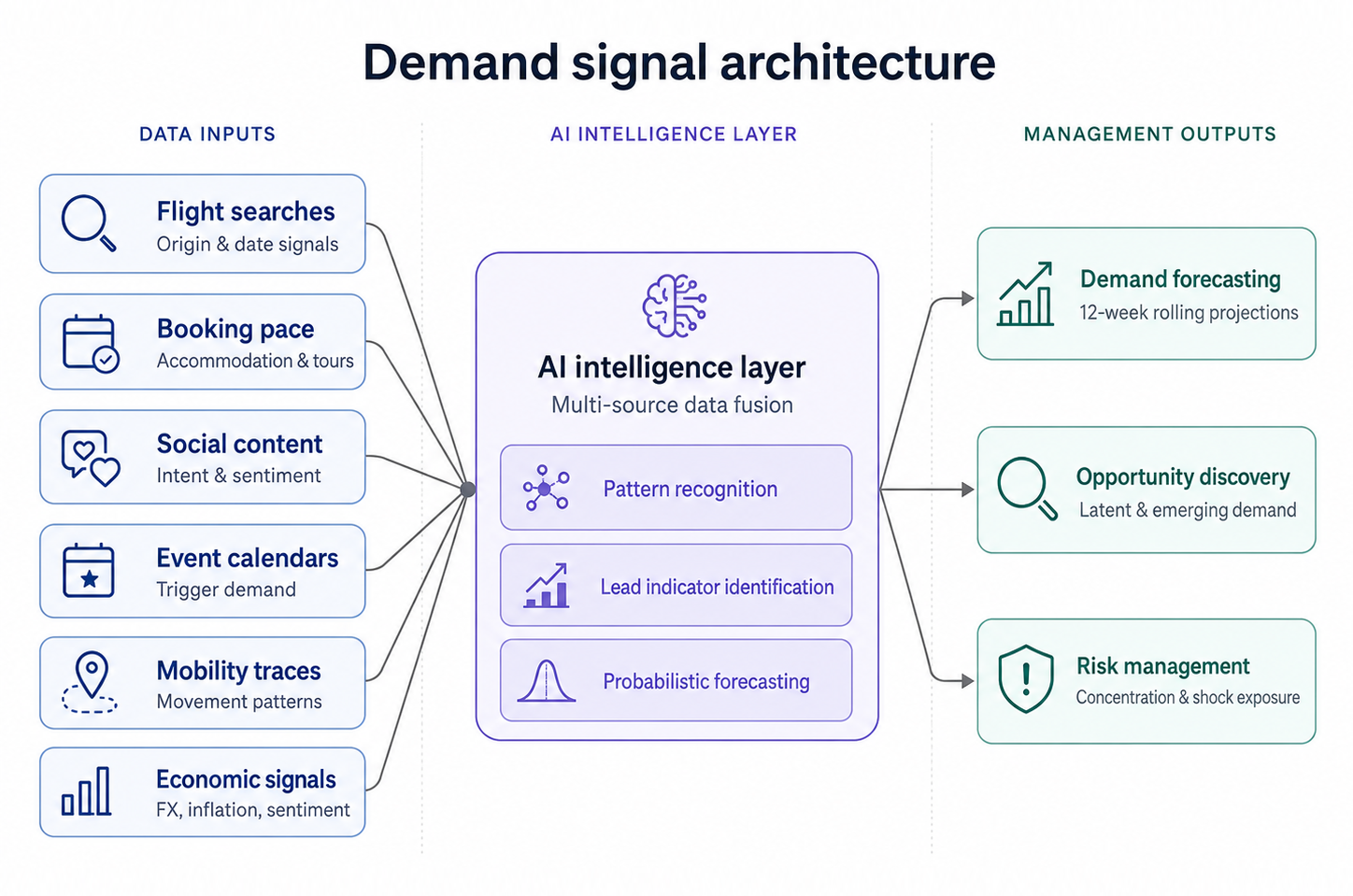
AI-based forecasting models, by contrast, integrate heterogeneous data streams and identify non-linear patterns that traditional econometric approaches miss. Research published in scientific literature shows that machine learning forecasting models trained on multi-source data, combining booking data, search behaviour, social content, economic indicators, and mobility traces, can achieve accuracy levels between 85% and 92% in visitor arrival prediction across multiple datasets, substantially outperforming traditional time-series approaches on short-to-medium-range forecasts.
For destination managers, this capability has two distinct uses that are often conflated but should be held separate.
Demand discovery: AI can identify emerging demand patterns, new source markets gaining interest in a destination, experience categories showing early-stage growth, segments underrepresented in current visitor data, before those patterns become visible in traditional metrics. This is not demand forecasting in the conventional sense; it is the identification of latent demand that current promotion and distribution architecture is failing to capture.
Demand risk management: Probabilistic modelling of demand trajectories allows DMOs to identify concentration risks, over-dependence on a single source market, seasonal compression into narrow windows, geographic clustering in high-capacity sites, and develop mitigation strategies before those concentrations create either overtourism pressures or vulnerability to demand shocks.
The practical implication is that DMO planning functions need to shift from describing historical demand to modelling probable futures. This is not a technology implementation challenge. It is an organisational capability challenge, requiring investment in data architecture, analytical skills, and decision-making processes that can act on probabilistic intelligence rather than requiring certainty before committing to a position.
Boards should note that this capability shift has a governance dimension. Decisions informed by probabilistic models require explicit frameworks for acting under uncertainty: thresholds for intervention, accountability structures for model-informed decisions, and audit mechanisms that can assess whether the intelligence being generated is actually informing strategy. The data infrastructure exists. The governance frameworks, in most DMOs, do not.
4. On-Ground Experience and Infrastructure Management
4. On-Ground Experience and Infrastructure Management
The visitor experience of a destination is inseparable from its infrastructure management. Congested approaches to popular sites, unpredictable queue times, degraded natural environments, and inadequate signage are not primarily visitor satisfaction problems. They are infrastructure load management failures with visitor satisfaction symptoms.
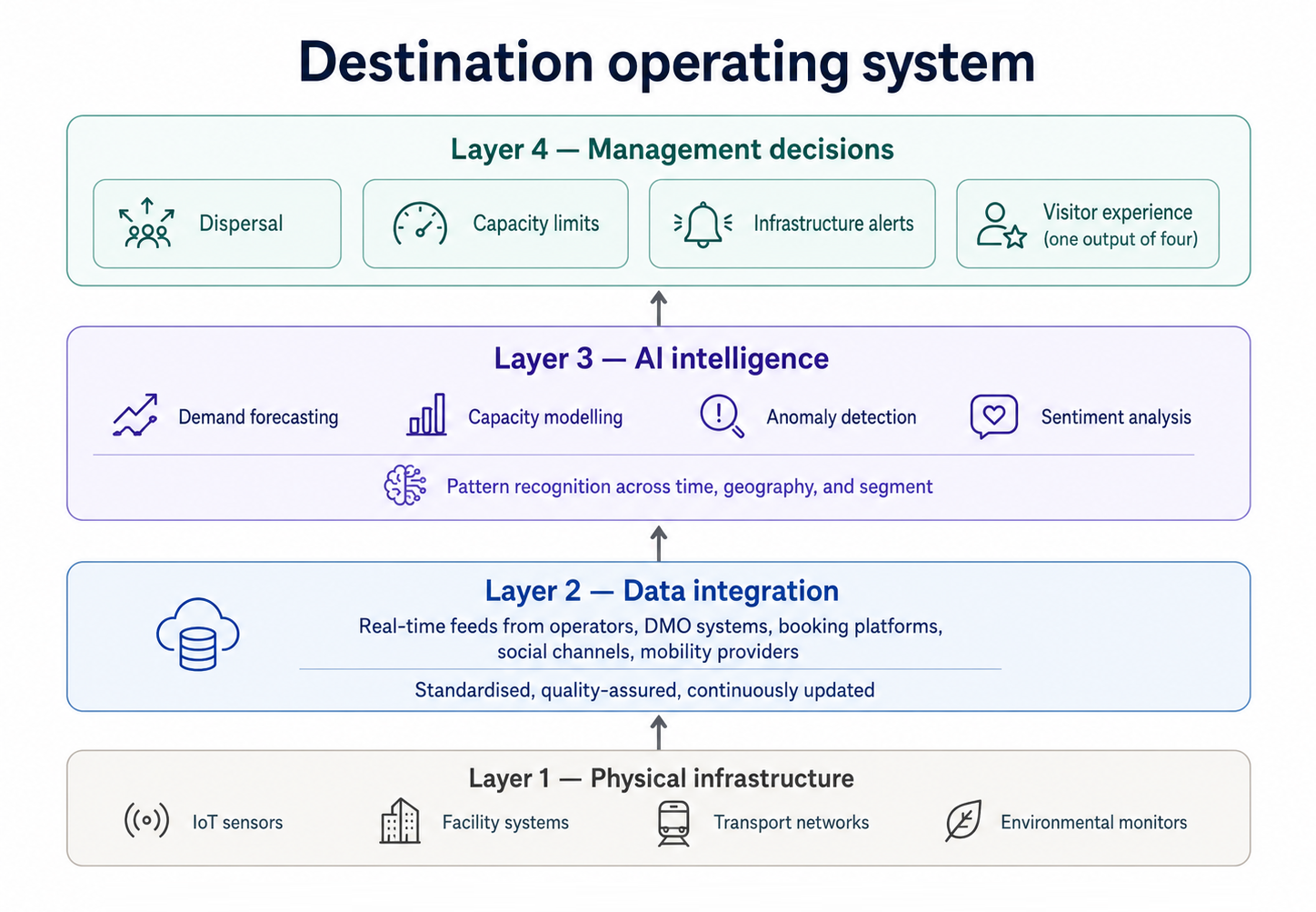
AI changes the capacity to manage infrastructure loads in real time. Sensor networks, mobility data, booking system integrations, and environmental monitoring feeds can be aggregated into destination operating dashboards that provide hour-by-hour visibility of visitor distribution across a region, not as a reporting tool for what has occurred, but as an intervention tool for what is about to occur.
The G7/OECD 2024 policy paper on AI and tourism specifically identifies visitor flow management as one of the highest-value AI application categories for destinations, noting that AI can increase the capacity of destination managers to track, anticipate, and sequence visitor flows while adjusting tourism and amenity services on demand through automation. Barcelona and Germany provide documented case examples of AI-assisted flow management at major attractions, demonstrating operational applicability, not just theoretical potential.
For Australian destinations, the most relevant applications span several operational domains:
- Real-time dispersal: AI-driven recommendation systems can redirect visitors toward lower-density sites and experiences when popular locations approach capacity thresholds, converting pressure from crowded sites into demand for underutilised operators and regions.
- Predictive maintenance: IoT sensor integration allows maintenance teams to address infrastructure failures before they affect visitor experience rather than after, reducing downtime at high-traffic facilities and extending asset life cycles.
- Dynamic capacity management: AI-enabled timed entry systems and booking flows can distribute visitor arrivals across sites and time windows, smoothing demand peaks without reducing aggregate visitation or revenue.
- Workforce deployment: Predictive models of visitor flows allow operators and DMOs to match staffing levels to actual demand, reducing both under-resourcing during peaks and labour costs during troughs.
The architecture underlying these applications is, in essence, a destination operating system: a data integration and intelligence layer that sits beneath visitor-facing services and provides management visibility across the full destination. Building this architecture requires investment, data-sharing agreements between operators and DMOs, and governance frameworks that address privacy, data use, and equitable distribution of capability across the operator ecosystem.
This is the honest complexity that most AI-in-tourism discourse avoids. The visitor-facing applications, chatbots, personalised itineraries, are relatively straightforward to deploy. The management intelligence layer is harder to build, requires cross-organisation cooperation, and delivers benefits that are less immediately visible but substantially more consequential.
5. Overtourism as a Governance Failure, Not a Volume Problem
5. Overtourism as a Governance Failure, Not a Volume Problem
Overtourism is routinely framed as a problem of too many visitors. It is more accurately described as a failure of destination intelligence: the inability to anticipate, distribute, and adapt to visitor demand before it exceeds the social, environmental, and infrastructure carrying capacity of a place.
The framing matters because it changes the solution space. If overtourism is a volume problem, the response is caps, taxes, and restrictions, essentially rationing access. If it is a governance failure, the response is better intelligence, earlier intervention, and more effective distribution of both visitors and economic benefit.
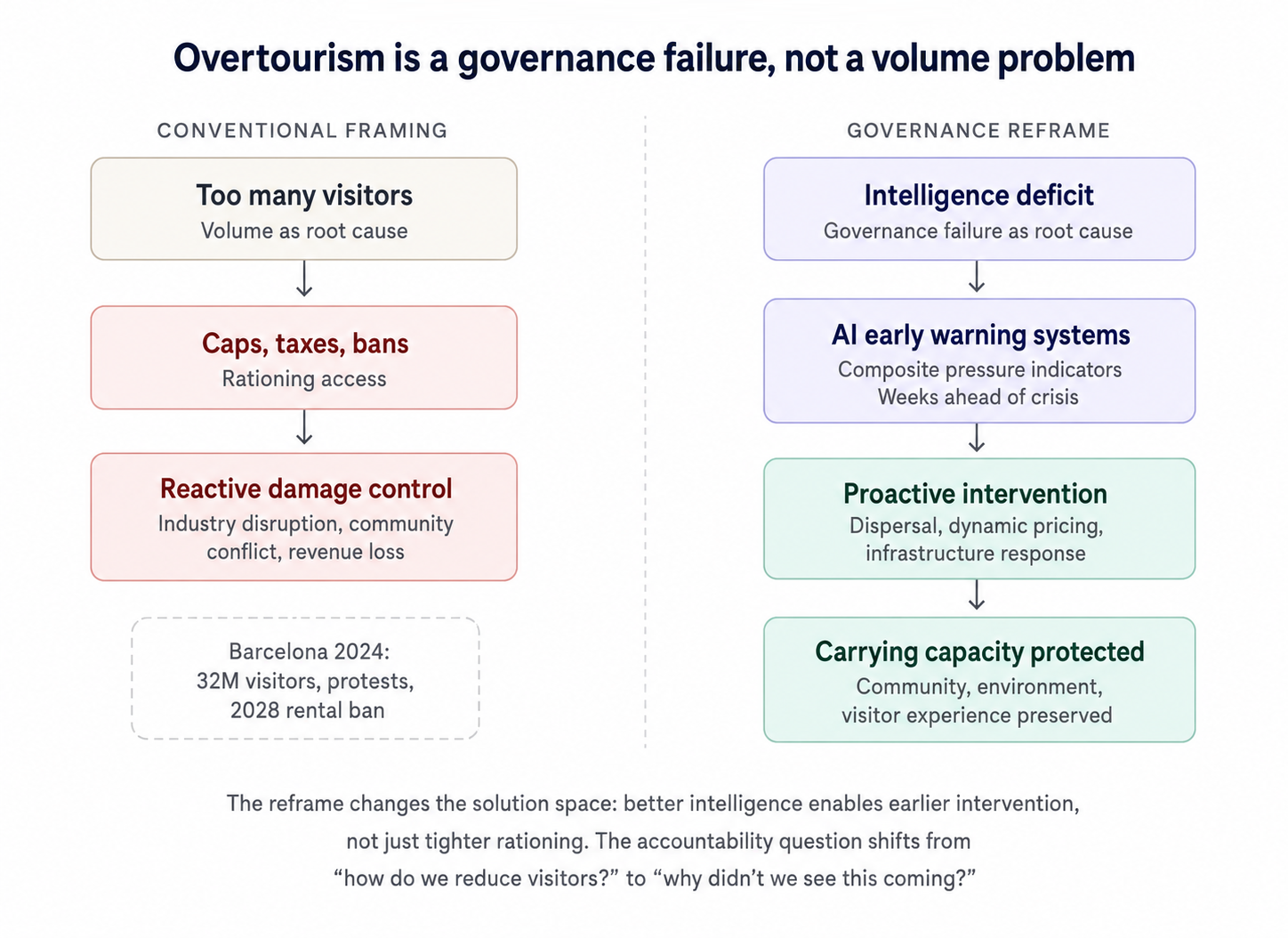
The evidence supports the governance failure framing. In 2024, Santorini reported up to 18,000 cruise passengers arriving daily against a resident population of 15,000. Barcelona's 32 million annual visitors have generated housing displacement and civic protests severe enough to prompt a 2028 ban on short-term tourist rentals. Japan, receiving a record 36 million international visitors in 2024, is considering systemic access limitations at major heritage sites. These are not outcomes of too much tourism. They are outcomes of management systems that had neither the early warning indicators nor the intervention tools to shape how tourism distributed across communities, sites, and time.
AI does not eliminate overtourism risk. But it fundamentally changes the lead time available for management response. Early detection systems that monitor composite indicators, correlating booking volumes, social media saturation, resident sentiment, environmental stress markers, and real-time mobility data, can identify pressure accumulation weeks or months before it becomes a crisis. That lead time is the difference between proactive management and reactive damage control.
Boards overseeing destinations where overtourism is either present or possible are not facing a technology adoption question. They are facing a governance accountability question: do we have the early warning systems and decision-making frameworks to intervene before community carrying capacity is exceeded?
This reframing has direct implications for how DMO boards structure their AI investments. Systems that generate earlier detection of carrying capacity pressure deliver governance value that visitor-facing AI cannot provide. The investment case is not visitor experience improvement, it is risk management and community stewardship, the core accountability of a destination management organisation.
For tourism operators, overtourism risk is also a commercial risk. Destinations that lose social licence face regulatory intervention, activism-driven visitor aversion, and the kind of reputational damage that takes years to reverse. Operators who understand this dynamic have a direct commercial interest in the intelligence infrastructure that prevents carrying capacity failure.
6. AI Discoverability: The New Marketing Layer
6. AI Discoverability: The New Marketing Layer
AI’s role in reshaping how travellers discover and plan trips is real and operationally significant, but it is one dimension of AI’s value in tourism, not the defining one. It belongs here, contextualised within the broader intelligence agenda, not as the frame for the whole conversation.
AI-driven search and answer engines have compressed the travel discovery and planning cycle in ways that directly affect DMO channel strategy. Research by Tourism Tribe in Australia found that Google AI Overviews, which launched in Australia in late 2024, were already returning reduced referral traffic to destination websites by up to 35% year-on-year in some cases. The implication is that AI agents, not human visitors to DMO websites, are increasingly the first point of contact between a traveller's intent and a destination's information. Tourism product that is not structured, verified, and AI-readable risks being absent from AI-generated itineraries regardless of its quality.
For operators, particularly the 78% of Australian tourism businesses that are sole operators or micro-teams, the practical requirement is structured, consistent, accurate business information across key platforms: the Australian Tourism Data Warehouse (ATDW), Google Business Profile, and destination websites. Inconsistency across these sources reduces AI recommendability. Accuracy and completeness of descriptions, including specific details about experiences, accessibility, and seasonal availability, determine whether AI agents include an operator in generated itineraries.
For DMOs, the implication is that part of their industry support function is evolving from content marketing to AI readiness facilitation: helping operators understand and meet the structured data standards that determine discoverability in AI-mediated search and recommendation environments.
This is an important operational shift. It is not, however, the strategic transformation. The strategic transformation is the one described in the preceding sections: from promotional bodies to destination intelligence organisations. AI discoverability is the consumer-facing tip of that deeper structural change.
7. What Boards and Executives Must Do Differently
7. What Boards and Executives Must Do Differently
The gap between AI's potential in destination management and its current deployment is not primarily a technology gap. The G7/OECD analysis of AI in tourism found that across the sector, marketing and sales remain the primary use cases for AI adoption, first in marketing, then in business administration. The management intelligence applications, demand forecasting, infrastructure management, overtourism risk, remain largely experimental. The technology is available. The organisational will and governance clarity are not.
For boards and executive leadership, three decisions define whether an organisation captures AI’s management intelligence value or remains in the experimental-chatbot phase.
Decision 1: Redefine what you are measuring
Decision 1: Redefine what you are measuring
DMOs have historically been measured on visitor arrivals, campaign reach, and industry satisfaction. These metrics are compatible with a promotional body. They are insufficient for a destination intelligence organisation. Boards need to authorise and drive a shift in the performance framework: adding lead indicators (demand signals, booking pace, early sentiment) alongside lag indicators, adding management outcomes (carrying capacity metrics, dispersal effectiveness, infrastructure load) alongside marketing outcomes, and adding community value metrics alongside industry metrics.
This is not a KPI exercise. It is a governance decision about what the organisation is responsible for and how that responsibility is measured. Without it, AI investments will be evaluated on their marketing impact and the management intelligence case will never be adequately funded.
Decision 2: Invest in the data foundation, not just the tools
Decision 2: Invest in the data foundation, not just the tools
AI systems perform at the quality of the data they are trained and operated on. The most common failure mode in tourism AI deployment is not poor tool selection, it is deployment of capable tools on inadequate data foundations: fragmented operator data, inconsistent collection methodologies, gaps in spatial and temporal coverage, and absence of the cross-organisation data-sharing agreements needed to build destination-wide intelligence.
Boards should require their executives to answer a specific question before any AI tool investment: what is the data architecture this system requires, and do we have it? The honest answer in most DMOs is that material investment in data foundations, integration, quality, governance, and operator onboarding, is a prerequisite for most of the high-value AI applications described in this paper. Funding the tools without the foundations produces expensive disappointment.
Decision 3: Assign governance accountability, not just oversight interest
Decision 3: Assign governance accountability, not just oversight interest
As of 2024, only 39% of Fortune 100 companies disclosed any form of board oversight of AI. Global surveys of directors find that 66% report limited to no knowledge or experience with AI, and nearly one in three say AI does not appear on their board agenda. This is not a DMO-specific problem, but it is a DMO-specific risk.
AI systems that inform destination management decisions, that flag capacity thresholds, recommend dispersal interventions, or influence which operators appear in AI-generated itineraries, carry governance accountability that cannot be delegated to a technology vendor or a marketing team. Boards need to establish clear accountability structures: who owns AI strategy, who reviews AI performance against community and governance outcomes, who is accountable when model-informed decisions cause harm, and how community and industry stakeholders participate in the governance of systems that affect their interests.
This is not bureaucratic caution. MIT research published in 2025 found that organisations with digitally and AI-capable boards outperformed their peers by 10.9 percentage points in return on equity. The governance investment pays.
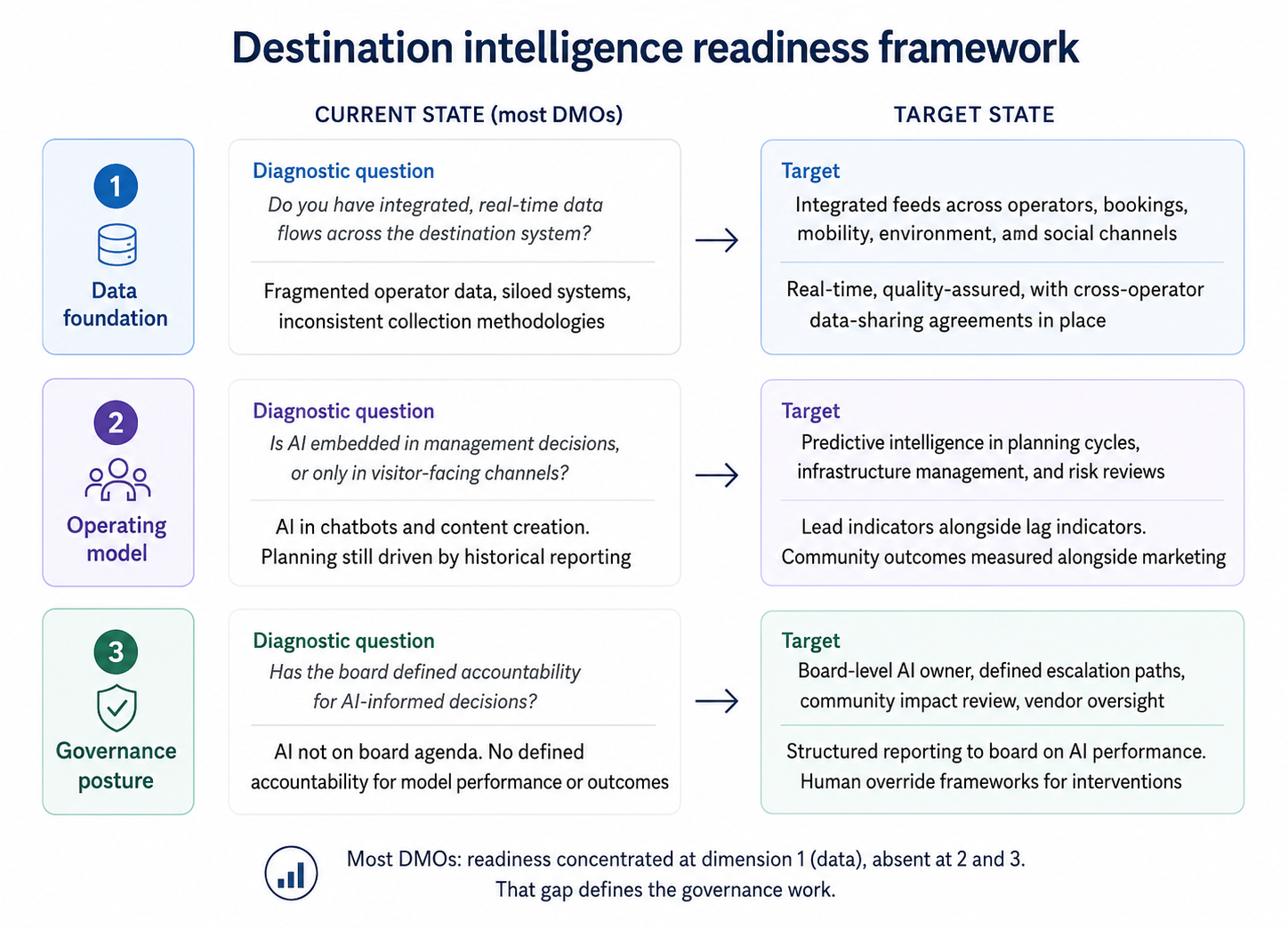
The Destination Intelligence Readiness question boards should be asking is not ‘are we using AI?’ but ‘are we using AI to manage the destination, or just to promote it?’ The answer determines the strategic value of everything else.
A Readiness Framework for DMO Boards
A Readiness Framework for DMO Boards
Boards and executive leadership can assess their organisation’s AI readiness across three dimensions:
Data Foundation: Does the organisation have integrated, real-time data flows across the destination system? Are operator data, mobility data, environmental indicators, and booking signals accessible in a form that supports AI modelling?
Operating Model: Is AI embedded in management decision-making, or only in visitor-facing channels? Do planning processes use predictive intelligence, or do they remain dependent on historical reporting?
Governance Posture: Has the board defined accountability for AI-informed decisions? Are there risk frameworks for model performance, data quality, and community impact? Is there a structured mechanism for human oversight of AI-driven interventions?
Most DMOs will find their readiness concentrated at the Data Foundation layer and absent at the Operating Model and Governance Posture layers. That gap defines the work.
Conclusion
Conclusion
Tourism has a data problem that looks like a technology problem. The tools to generate better destination intelligence exist. What most organisations lack is the clarity of purpose to define what they want that intelligence to do, the data foundations to make it reliable, and the governance structures to ensure it is used accountably.
AI’s most consequential contribution to destination management is not the itinerary chatbot or the personalised recommendation engine. It is the capacity to shift the fundamental operating orientation of tourism organisations from reactive description to proactive intelligence: anticipating demand before it overwhelms, discovering opportunity before competitors identify it, detecting carrying capacity pressure before it becomes community conflict, and managing infrastructure before it fails visitor experience.
DMOs that make this shift will occupy a different strategic position than those that do not. They will have better evidence for investment decisions, stronger accountability to community stakeholders, and the early warning systems that make the difference between managing tourism and being managed by it.
The boards and executives who understand this distinction have a decision to make: not about which AI tools to purchase, but about what kind of organisation they want to lead. The technology follows that decision. The governance structures follow it. The community outcomes follow it.
The question is not whether AI will reshape destination management. It already is. The question is whether that reshaping will be led by the organisations responsible for destination stewardship, or by the technology vendors and platforms that will gladly fill the vacuum if it is not.
References
Australian Bureau of Statistics. (2025). Tourism satellite account, 2024–25 financial year. Australian Bureau of Statistics. [Australian Bureau of Statistics](https://www.abs.gov.au/statistics/economy/national-accounts/tourism-satellite-account/latest-release) Tourism Research Australia. (2025). National tourism satellite account. Austrade. [Austrade](https://www.tra.gov.au/en/economic-analysis/tourism-satellite-accounts/national-tourism-satellite-account) OECD. (2024). Artificial intelligence and tourism: G7/OECD policy paper (Tourism Papers No. 2024/02). OECD Publishing. [OECD Publishing](https://doi.org/10.1787/3f9a4d8d-en) Tourism Tribe. (2025). State of artificial intelligence in tourism, 2025 edition. Tourism Tribe. [Tourism Tribe](https://www.tourismtribe.com/australian-tourism-sector-faces-ai-turning-point/) Tourism Tribe. (2026, April). AI search is transforming tourism marketing in Australia. Tourism Tribe. [Tourism Tribe](https://www.tourismtribe.com/ai-search-transforming-tourism-marketing/) Digital Tourism Think Tank. (2024). Strategic AI grounding: A framework for DMO digital transformation. Digital Tourism Think Tank. [Digital Tourism Think Tank](https://www.thinkdigital.travel/opinion/strategic-ai-grounding-a-framework-for-dmo-digital-transformation) Lalli, M. (2025, November). The AI disruption: Why destination marketing organisations must reinvent themselves now. Medium. [Medium](https://medium.com/@mkl/the-ai-disruption-why-destination-marketing-organisations-must-reinvent-themselves-now-760346bf8649) Sapien Data. (2026, February). 2026 data and analytics trends for tourism. Sapien Data. [Sapien Data](https://www.sapiendata.com.au/insights/2026-data-and-analytics-trends-for-tourism/) Wang, C., Xue, H., & Wang, S. (2025). High-frequency tourist flow forecasting with gated recurrent units and attention mechanisms. Tourism Management Perspectives. [Tourism Management Perspectives](https://doi.org/10.1177/21582440251358303) McKinsey & Company. (2025, December). The AI reckoning: How boards can evolve. McKinsey & Company. [McKinsey & Company](https://www.mckinsey.com/capabilities/mckinsey-technology/our-insights/the-ai-reckoning-how-boards-can-evolve) World Tourism & Travel Council (WTTC). (2025). Australia’s travel & tourism sector set to reach record $315BN in 2025. WTTC. [World Travel & Tourism Council](https://wttc.org/news/australias-travel-tourism-sector-set-to-reach-record-315bn-in-2025) Road Genius. (2024). What is overtourism? Statistics & news 2024. Road Genius. [Road Genius](https://roadgenius.com/statistics/tourism/global-overtourism/) International Journal of Future Management Research. (2025). Integrating artificial intelligence into destination management organisation (DMO) infrastructure. IJFMR. [International Journal of Future Management Research](https://www.ijfmr.com/papers/2025/6/60076.pdf)